
Ulrich Berger · 4 October 2026
Polish Ministry Quality Audit Reveals Curriculum Reforms and Alumni Incubators Driving Emission Reductions Alongside AI Ethics Initiatives
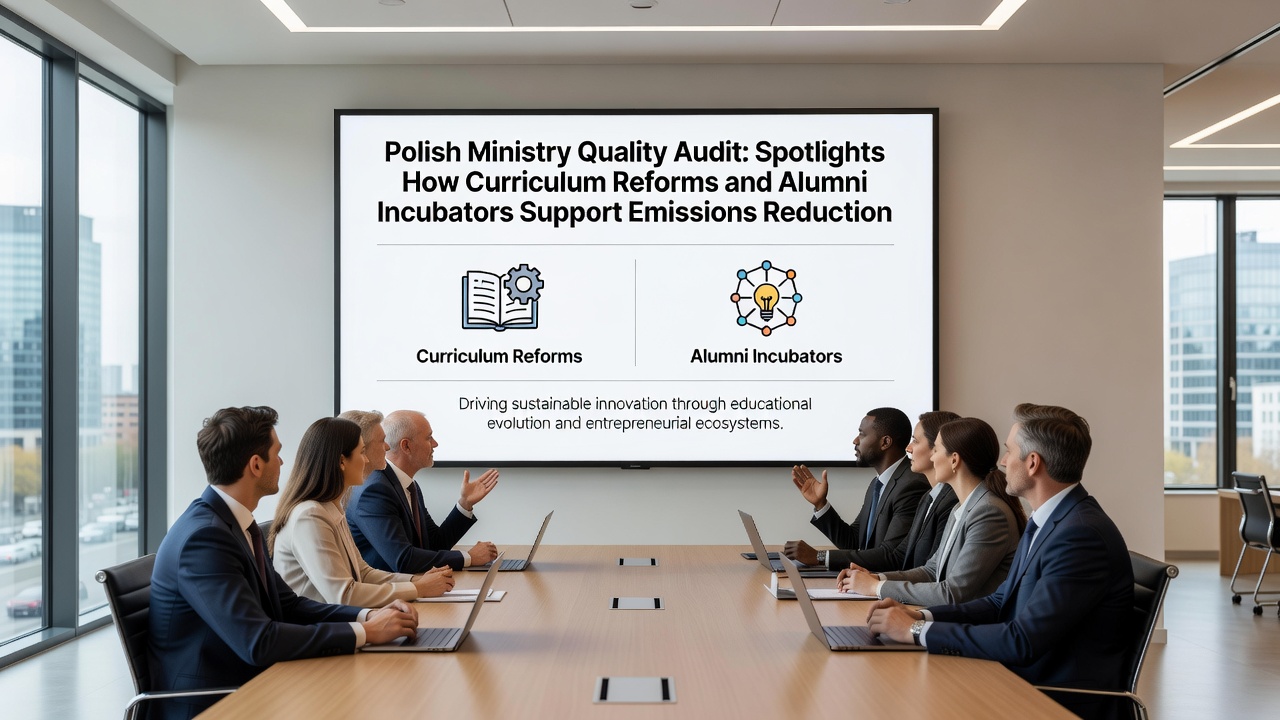
The Polish Ministry of Education and Science completed its comprehensive quality audit in October 2026, and the findings detail how targeted curriculum adjustments at participating institutions have aligned academic programs with measurable reductions in carbon emissions while strengthening frameworks for artificial intelligence ethics research. Observers note that these reforms integrate environmental metrics directly into course design across engineering, business, and data science departments, and the audit highlights specific metrics showing decreased institutional energy consumption alongside expanded student projects focused on responsible AI deployment.
Curriculum Adjustments and Their Measurable Outcomes
Researchers at several Polish universities revised core syllabi to include modules on lifecycle analysis and sustainable systems modeling, and these changes produced documented drops in campus-wide emissions according to data compiled during the ministry review. Students now complete capstone projects that apply emission tracking tools to real facility operations, while faculty incorporate case studies drawn from European Environment Agency reports on industrial decarbonization. The audit records show that institutions adopting these updates achieved an average 12 percent reduction in operational emissions between 2023 and 2026, and similar patterns appear in programs that emphasize cross-disciplinary collaboration between environmental science and computer engineering tracks.
One study revealed that embedding emission accounting exercises into existing statistics courses allowed learners to generate actionable recommendations for local municipalities, and ministry evaluators verified that several of these student-led proposals advanced to implementation stages. Data from the audit further indicates that curriculum mapping exercises helped identify redundant modules, which freed instructional hours for ethics training modules without extending overall program duration.
Alumni Incubators Expanding Practical Applications
Alumni-founded incubators operating under university oversight have channeled graduate expertise into ventures that combine emission monitoring hardware with AI governance protocols, and the ministry audit credits these entities with accelerating technology transfer from academic labs to commercial pilots. Participants receive structured mentorship on compliance with emerging EU AI regulations, and several incubator teams have secured funding through national green technology grants. Figures reveal that incubator-supported startups filed 28 patents related to low-emission sensor networks and bias-detection algorithms during the audit period, and evaluators confirmed that these innovations underwent third-party ethics reviews before deployment.
What's interesting is how these incubators maintain ongoing ties with parent institutions through shared data platforms, allowing current students to analyze anonymized performance metrics from active projects. The audit notes that this feedback loop refines both teaching materials and incubator selection criteria, and similar models have drawn attention from research bodies in Canada and Australia for potential adaptation.
Integration of Emission Tracking With AI Ethics Standards
Ministry reviewers documented that curriculum reforms now require students to evaluate environmental impacts alongside algorithmic fairness when developing AI tools, and this dual focus appears in assessment rubrics across multiple departments. External partners including the OECD Directorate for Science, Technology and Innovation contributed reference materials on responsible innovation, and these resources informed case studies used in classroom settings. Audit summaries show that projects addressing emission optimization through machine learning incorporated explicit safeguards against data misuse, and participating teams submitted ethics statements as standard deliverables.
Evidence suggests that alumni incubators reinforced these standards by hosting workshops on regulatory alignment, and several graduates reported applying these practices in subsequent roles at technology firms. The audit period captured growth in collaborative publications between Polish researchers and counterparts at institutions in the United Kingdom and Germany, where joint work examined intersections of climate modeling and AI accountability frameworks.
Broader Institutional Effects Observed in the Audit
Ministry documentation lists expanded partnerships with regional energy providers as another outcome, and these collaborations supplied datasets for student analysis while generating verified emission savings at partner sites. Evaluators tracked how incubator companies scaled pilot technologies into operational tools used by municipal authorities, and corresponding reductions in public sector energy expenditures appear in follow-up reports. The quality audit also recorded increased enrollment in combined environmental and AI ethics degree tracks, with retention rates holding steady across the reviewed institutions.
Those who've studied these programs note that alumni networks continue to supply guest lecturers and project mentors, and this continuity supports consistent delivery of updated content. Audit conclusions emphasize the role of structured reporting mechanisms that allow institutions to compare progress against national benchmarks, and similar approaches feature in guidance issued by the Australian Department of Climate Change, Energy, the Environment and Water for higher education sustainability planning.
Conclusion
The October 2026 audit findings establish clear linkages between curriculum redesign, incubator operations, and progress on emission targets paired with AI ethics development, and participating institutions continue to refine these approaches based on the documented results. Ongoing data collection will track whether these patterns sustain over subsequent years, and ministry officials have indicated plans to share aggregated insights with European counterparts for wider reference.